
Blog · Gestionale
Customer 360 View: Build a Single Customer View in Italy
A customer 360 view is one profile per customer that gathers what your company knows from every system: orders, invoices, payments, support requests, web activity and marketing contacts. TechTarget describes it as compiling data from multiple touchpoints into one integrated view. For a small or medium business, the practical way to get there is rarely a new platform. It is making your CRM, ERP and e-commerce store share one customer record, with clear rules on who owns each field.
This guide explains what the view contains, how to build it step by step, where projects fail, and what Italian privacy rules mean for the data you combine.
TL;DR
- A customer 360 view (also called a single customer view) is one unified record per customer, fed by CRM, ERP, e-commerce and marketing tools.
- For most SMEs, the foundation is a clean customer master record in the ERP, connected through APIs to CRM and online store, not a separate platform.
- The main obstacles are manual data entry, duplicate records and missing governance, not software features.
- In Italy, combining customer data for profiling and marketing triggers privacy duties, including retention limits and clear purposes.
- Start small: pick two or three questions the view must answer, then connect only the data needed to answer them.
Table of Contents
- What a customer 360 view actually is
- Which data goes into the profile
- Why build one: what you gain
- How to build a single customer view, step by step
- CRM, ERP or customer data platform: which do you need?
- Where projects fail
- Privacy rules when you combine customer data
- Perspective
- How Linkware can help
- FAQ
What a customer 360 view actually is
The idea is simple. Today a customer’s data sits in several places. Sales has the quotes in the CRM. Administration has invoices and payment terms in the ERP. The online store has the web orders and the email address used at checkout. Customer service has a shared mailbox or a ticketing tool. Each system tells part of the story, and nobody sees all of it.
A customer 360 view consolidates these fragments so that anyone authorized can open one profile and see the whole relationship. You will also see it called a single customer view or unified customer data. The names differ, the goal is the same: one reliable answer to the question “who is this customer and what have we done together?”
Three features separate a real 360 view from a simple report:
- One identity. The same customer is recognized across systems, even if the name is spelled differently or the order came from a different channel.
- Current data. The profile updates when a source changes, not once a quarter through a spreadsheet export.
- Shared access. Sales, administration, service and marketing all read the same record, with permissions that match their role.
If you want to see how the architecture of connected touchpoints looks in a service context, this piece on automating customer onboarding shows how a unified profile supports each step of a customer’s first weeks.
Which data goes into the profile
Not everything belongs in it. A useful profile combines identity, transactions and interactions. Italian regulator decisions on customer relationship management give a realistic picture of what companies actually merge: the Garante’s decision on Dolce & Gabbana describes CRM data that combines personal and contact details, purchase amounts and details, and marketing attributes collected through shops, the company portal and e-commerce. In its 2017 Brunello Cucinelli decision, it describes combining offline purchases, online browsing and direct-marketing activity for customer care, post-sale assistance and promotions.
For a B2B company or a retailer in the SME range, the typical map looks like this:
| Data group | Typical source | Examples | Who uses it |
|---|---|---|---|
| Identity | ERP customer master, CRM | Company name, VAT number, contacts, delivery addresses, SDI code | Everyone |
| Commercial | ERP, e-commerce | Orders, price lists, discounts, agent, order frequency | Sales, management |
| Financial | ERP accounting | Invoices, payment terms, open items, credit limit | Administration, sales |
| Interaction | CRM, helpdesk, email | Calls, visits, quotes, tickets, contracts | Sales, service |
| Digital behavior | Online store, newsletter tool | Web orders, carts, email opens, consents | Marketing, e-commerce |
The left column matters most. If identity data is wrong, every other group attaches itself to the wrong person. That is why unified customer records in the ERP are the first thing to fix.
Why build one: what you gain
TechTarget lists unified profiles, segmentation, a better customer experience, data-driven decisions, stronger customer service and operational efficiency as the main benefits. In an Italian SME, these translate into concrete situations:
- Sales sees the money. Before a rep offers a new discount, they see that the customer has two overdue invoices, or that their order volume has doubled.
- Service sees the history. A customer calls about a delivery. The person answering sees the order, the shipment, the earlier complaint and the contract in one screen.
- Marketing targets real segments. Instead of mailing the whole list, you select customers who bought a product line last year and have not reordered.
- Management reads one set of numbers. Revenue per customer, margin and payment behavior come from the same source, which is what business intelligence on top of an ERP relies on.
- Fewer duplicated tasks. Nobody retypes a new customer into three systems.
These gains depend on data quality. A 360 view built on duplicates and outdated addresses simply spreads the errors faster.
How to build a single customer view, step by step
1. Define the questions first
Write down three to five questions the view must answer. Examples: which customers are at risk of leaving, which accounts are profitable after discounts and returns, which online buyers are also wholesale customers. Without questions, projects collect every field and use none.
2. Map your sources and choose the master
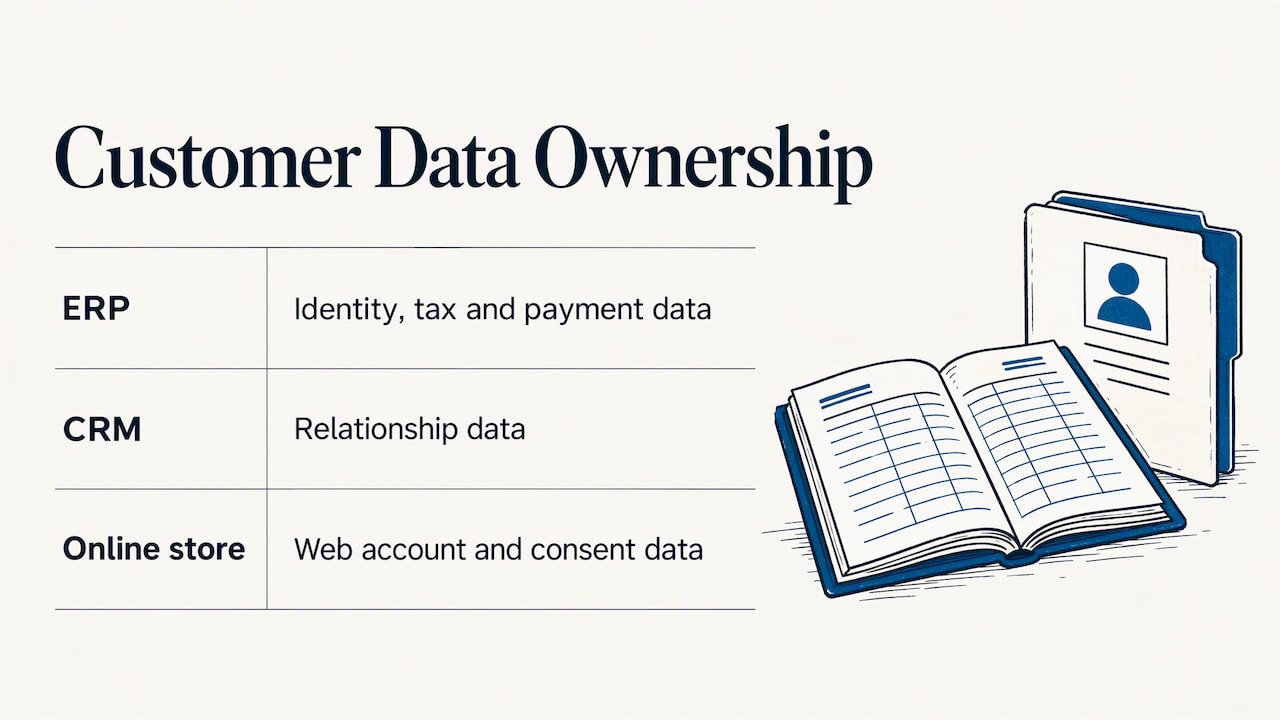
List every system holding customer data, including spreadsheets and agents’ phones. Then decide which system is the master for each field. In most Italian SMEs the ERP should own identity, tax and payment data, because invoicing through the SDI needs it to be exact. The CRM owns relationship data, and the online store owns web account and consent data.
3. Clean before you connect
Deduplicate, standardize addresses and VAT numbers, and fill the gaps. Doing this after integration means fixing the same error in several places.
4. Resolve identities
The same customer will appear under different spellings, emails or channels. AWS recommends identity resolution, profile aggregation, enrichment and segmentation as core stages of a customer-360 data strategy. In practice, for a B2B company, the VAT number or a unique customer code is the strongest matching key. For consumers, a verified email plus the tax code (where legitimately collected) does the job.
5. Connect systems through documented interfaces
Use APIs rather than file exports whenever the systems allow it. The AgID guidelines for the national interoperability platform are written for public administrations, not private companies, but the technical principles carry over well: API-based exchange, documented interfaces, authorization levels and access logging. AWS also suggests making the consolidated customer record the primary reference for downstream applications such as e-commerce platforms and CRM systems.
For an online store, this means orders, customers and prices flow both ways with the ERP. A practical walkthrough is in our guide to WooCommerce and ERP integration. If you also sell on marketplaces, the same logic applies to marketplace and ERP integration, and invoicing from web orders needs to pass the SDI without rejections.
6. Add the CRM and marketing layer
Once the master data is stable, connect the CRM so that contacts, opportunities and contracts attach to the same customer code. Marketing automation then reads the same profile, which is the point of integrating CRM and marketing.
7. Publish, measure and maintain
Give each team a view that matches its job, then check use after 60 to 90 days: how many records are complete, how many duplicates appear each month, how often people still ask for an export. Assign an owner for data quality. A view nobody maintains degrades within a year.
For retailers selling in store and online, the same steps apply across channels. Our guide to omnichannel retail with ERP data covers the six-phase version of this process.
CRM, ERP or customer data platform: which do you need?
A frequent point of confusion is whether a customer data platform (CDP) replaces a CRM. It does not, because they do different jobs.
| CRM | ERP | CDP | |
|---|---|---|---|
| Main purpose | Manage relationships, opportunities, contracts | Run orders, stock, production, accounting | Collect and unify customer data from many sources |
| Typical data | Contacts, activities, quotes | Invoices, payments, items, prices | Web, social, CRM and other behavioral data |
| Main users | Sales, service | Administration, logistics, production | Marketing, analytics |
| Best when | You need to follow accounts and pipeline | You need one source for transactions | You have large volumes of anonymous and multi-channel data |
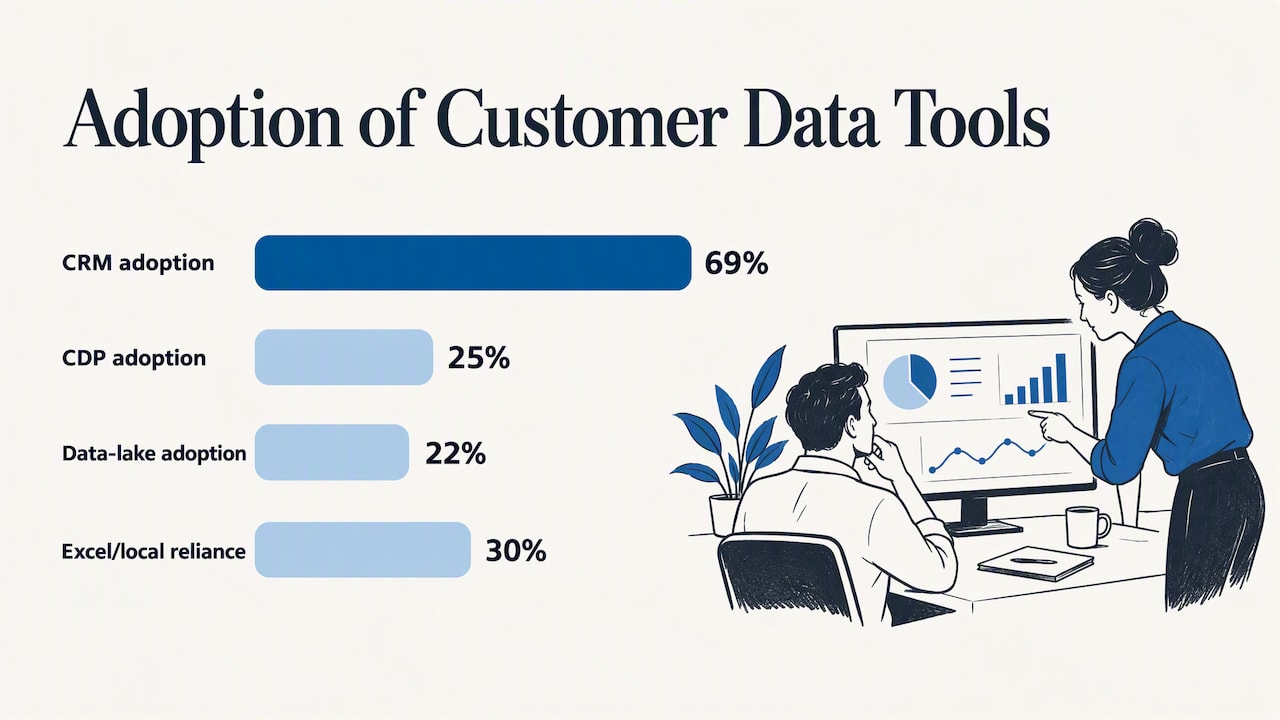
The 2025 CMMC report describes CDPs as collecting and unifying customer data from sources such as websites, social media and CRM, and centralizing it for shared access and analysis. That is valuable for companies with heavy digital traffic. According to the Politecnico di Milano Observatories’ October 2026 release on B2B digital commerce, CRM adoption among large Italian companies is 69%, while CDP and data-lake adoption is 25% and 22%, and 30% still rely heavily on Excel and local databases.
For most SMEs, the order is clear: first a clean ERP customer master, then a CRM connected to it, and a CDP only when the volume of digital data justifies another layer. Many SMEs reach a usable 360 view with just the first two.
Where projects fail
Technology is rarely the cause. The SDA Bocconi survey published on 18 May 2026 found that 76.9% of companies have a CRM and 64% of adopters integrate it with the ERP. Yet 47% of staff enter data manually, 37.5% of companies have no data-governance policy, and 65.5% of staff spend at least an hour a week searching for or correcting data. Owning a CRM connected to an ERP does not by itself create customer intelligence.
The 2025 CMMC roadmap lists the same problems from another angle: silos and non-interoperable systems, incomplete or outdated data, weak cleansing and deduplication, unclear governance roles, insufficient skills, vague business goals, and infrastructure or security controls that do not scale. It frames data-driven transformation as an organizational change, not a software purchase.
A short checklist to test your own situation:
- Can you name the system that owns each customer field?
- Is a new customer entered once, or in several places?
- Does one person own data quality?
- Can sales see invoice status without calling administration?
- Do you know which consent the customer gave, and where it is stored?
Three or more “no” answers mean the first investment is process and data, not another tool.
Privacy rules when you combine customer data
Merging data from several systems is processing under the GDPR, and in Italy the Garante has ruled on customer profiling in detail. Treat the following as case-based guidance and have your DPO or legal adviser confirm what applies to your company.
- Purpose and consent. Profiling and marketing need a clear purpose and, where required, specific consent, stored with the profile. The Garante decisions cited above concern companies combining offline and online data for profiling and promotions.
- Retention. In its Dolce & Gabbana decision, the Garante allowed retention for profiling and marketing for a maximum of seven years in that specific case, subject to relevance and proportionality, followed by deletion or irreversible anonymization. The 2018 decision on PC S.r.l. reached a similar seven-year limit, again as a case-specific period. It is not a general rule you can copy; set your own retention schedule and document it.
- Access control. A unified profile concentrates information, so permissions by role and access logs matter more, not less. Security testing of any AI or analytics tool that touches the profile is part of that, as with AI data leakage testing.
- Data location. Know where the data physically sits. Our managed services run in the cloud or on dedicated servers in Italy.
If your profile feeds profiling or automated decisions, involve your data protection officer before launch, not after.
Perspective
In our thirty years of working with Italian SMEs, we have seen the same pattern: companies ask for a “360 view” and then discover that the real problem is that three people keep three different versions of the same customer.
Our position is that the 360 view starts in the management system. When accounting, production and sales live in one ecosystem, the customer record is already shared. The CRM and the online store then plug into it instead of creating a fourth version.
This is also why we assign each client a dedicated consultant who studies their processes, rather than routing them to a call center. A unified profile only works if someone understands how your company really takes orders, grants credit and handles complaints. Our team handles development and user assistance internally, so configuration follows your operations, not the other way round.
Start with identity and master data, connect your store and CRM, and add analytics once the numbers are trusted.
Claudio
How Linkware can help
We configure ERP software for manufacturing, retail, commerce, logistics, professional studios and e-commerce, including Passepartout-based solutions, and connect it to l'integrazione con WooCommerce and PrestaShop stores. Our Passepartout CRM keeps clients, sales and contracts tied to the same customer record as the ERP, and business intelligence dashboards read from it.
If you want to see what a unified customer record would look like with your own data, a first conversation with a consultant is the place to start.
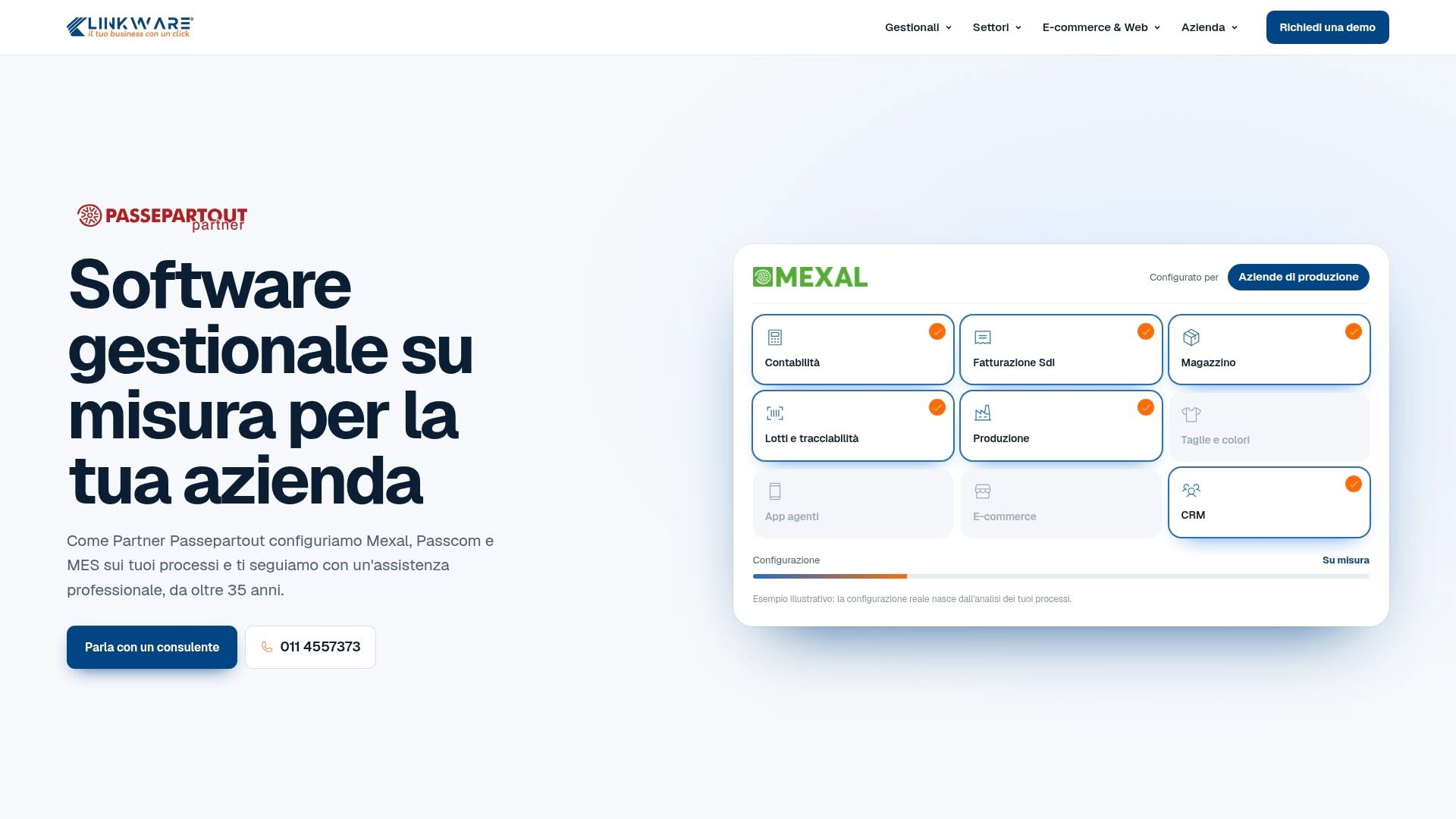
Request a demo with a Linkware consultant and bring your current list of systems: we will map where your customer data lives and what to connect first. If your store is the main gap, see our e-commerce creation and integration services.
FAQ
What is the difference between a customer 360 view and a single customer view?
In everyday use they mean the same thing: one consolidated profile per customer. Customer 360 usually stresses the breadth of data (transactions, interactions, behavior), while single customer view stresses the unified, deduplicated identity. In both cases the practical test is whether any authorized person sees the same facts.
Do I need a customer data platform to get a 360 view?
Not necessarily. Many SMEs reach a useful view by connecting a well-kept ERP customer master with a CRM and the online store. A CDP becomes relevant when you collect large volumes of web, app and social data that the CRM and ERP are not designed to handle.
How long does it take to build one?
It depends on data quality and the number of systems, so no honest figure applies to every company. A narrow first phase, such as ERP plus CRM plus store with a cleaned customer master, is far faster than a company-wide program. Plan the first release around two or three business questions and extend from there.
Is it legal to combine customer data from different systems in Italy?
It can be, provided you have a legal basis, a defined purpose, appropriate information to customers, consent where required for profiling or marketing, and a documented retention period. The Garante has issued case-by-case decisions on profiling. Ask your DPO or legal adviser to review the design before you go live.
What is the most common reason a 360 view fails?
Poor data and unclear ownership. Manual entry, duplicates and no governance policy are widespread, as the SDA Bocconi survey shows. Fix the customer master and name an owner for data quality before adding more tools.
Recommended
Vuoi digitalizzare la tua azienda?
Un consulente LINKWARE ti propone la soluzione su misura, senza impegno.
Richiedi una demo gratuita