
Blog · Gestionale
Inventory Valuation in an ERP: FIFO, LIFO and Weighted Average

Inventory valuation in an ERP means the system assigns a cost to every unit that enters or leaves your warehouse, using a method you choose (FIFO, LIFO or weighted average), and posts the result to your accounts. The method you configure decides your cost of goods sold, your closing stock value and, in Italy, the figures that appear in your financial statements. This guide explains how each method works, what Italian rules allow, and what to verify before you set it up.
TL;DR
- An ERP values stock by applying a cost-flow method to each movement, then keeps the stock subledger aligned with the general ledger.
- FIFO leaves the most recent costs in closing stock. Weighted average blends costs. LIFO leaves the oldest costs in stock.
- In Italy, Article 2426 of the Civil Code allows weighted average, FIFO and LIFO for interchangeable goods, and OIC 13 requires valuation at the lower of cost and realizable value.
- Choose the method before go-live, apply it consistently, and test it on real purchase and sales data.
Table of Contents
- What inventory valuation means in an ERP
- How the ERP connects stock movements to the general ledger
- The three methods compared
- A worked example with the same data
- What Italian rules require
- How to choose the method for your business
- Configuration checklist for an Italian company
- Common mistakes
- Configuring valuation with Linkware
- FAQ
What inventory valuation means in an ERP
Inventory valuation answers one question: what is the stock on your shelves worth in euros? A spreadsheet can answer it once a year. An ERP answers it with every receipt, shipment, production order and return.
Each stock movement carries a quantity and a cost. When goods arrive, the system records the purchase cost. When goods leave, it must decide which cost to assign to the units sold. That decision is the valuation method. The same warehouse with the same purchases produces different margins and different closing values depending on the method.
In an integrated ERP, the valuation is not a separate report. It is the link between the warehouse and the books:
- A goods receipt increases the stock quantity and the stock value.
- A sale or a consumption in production reduces both and creates a cost of goods sold entry.
- Adjustments, such as inventory counts, scrap and returns, are valued with the same logic.
This is why the choice belongs to accounting as much as to operations. If you want a broader view of how the ledger and sales side connect, see our guide on unifying accounting and sales in a single ERP.
How the ERP connects stock movements to the general ledger
Most ERPs offer two ways to reflect inventory in accounting. The names vary by product, but the logic is the same.
Periodic or manual valuation. Warehouse staff record movements in quantity, and the accounting team posts the value at period end, usually after a physical count. The ledger is accurate only at those moments.
Perpetual or automatic valuation. Each stock movement generates an accounting entry at the time it happens. Product documentation for open-source ERPs describes this as a stock valuation account, a stock journal and input and output accounts that are posted when goods move, as in this overview of automated inventory valuation. In a perpetual setup, the stock account in the ledger should always match the total value in the stock subledger.
For a small or medium Italian business, perpetual valuation brings three practical benefits:
- Margins by product, customer or order are visible as sales happen, not weeks later.
- The month-end close is shorter, because the stock reconciliation is mostly done already.
- Differences between the stock report and the ledger become a signal to investigate, not a surprise.
The ledger postings depend on a clean accounting structure. If your journal entries are still partly manual, our guide to automatic prima nota for SMEs shows how movements become entries without re-keying.
The three methods compared
The three cost-flow methods differ only in which costs they assume leave stock first. Academic course material on cost flow assumptions describes them in the same way: FIFO assumes the oldest items are sold first, LIFO the newest, and weighted average uses a mean cost per unit.
FIFO (first in, first out)
The oldest purchase costs are assigned to goods sold. Closing stock is valued at the most recent costs, so it is close to current replacement cost. FIFO fits goods with a natural rotation, such as perishables, spare parts with expiry or fashion items, and it is easy to explain to an auditor.
Weighted average
The system calculates a blended cost per unit: total cost of goods available divided by total units available. In an ERP this is often recalculated after every receipt (a moving average) or at the end of the period. It smooths price swings and suits commodities, raw materials and components that are physically mixed, such as bulk materials or screws kept in one bin.
LIFO (last in, first out)
The most recent costs are assigned to goods sold, and the oldest costs stay in stock. With rising prices, cost of goods sold is higher and closing stock lower than under FIFO. Before you consider it, check the reporting framework you follow, as explained below.
A worked example with the same data
Take a single item. You buy 100 units at €10, then 100 units at €12. You then sell 120 units. Total cost available is €2,200 for 200 units. These figures are illustrative.
| Method | Cost of goods sold | Closing stock (80 units) | Calculation |
|---|---|---|---|
| FIFO | €1,240 | €960 | 100 × €10 + 20 × €12 sold; 80 × €12 left |
| Weighted average | €1,320 | €880 | €2,200 ÷ 200 = €11 per unit |
| LIFO | €1,400 | €800 | 100 × €12 + 20 × €10 sold; 80 × €10 left |
The three results sum to €2,200 each time. Only the split between the income statement and the balance sheet changes. The same pattern is described in the course material above: with rising prices, FIFO gives lower cost of goods sold and higher ending inventory, and LIFO gives the opposite.
The practical consequence is that a method change is not cosmetic. It moves profit, and therefore taxes and ratios that banks look at. That is the reason to decide it deliberately, not by accepting the ERP default.
What Italian rules require
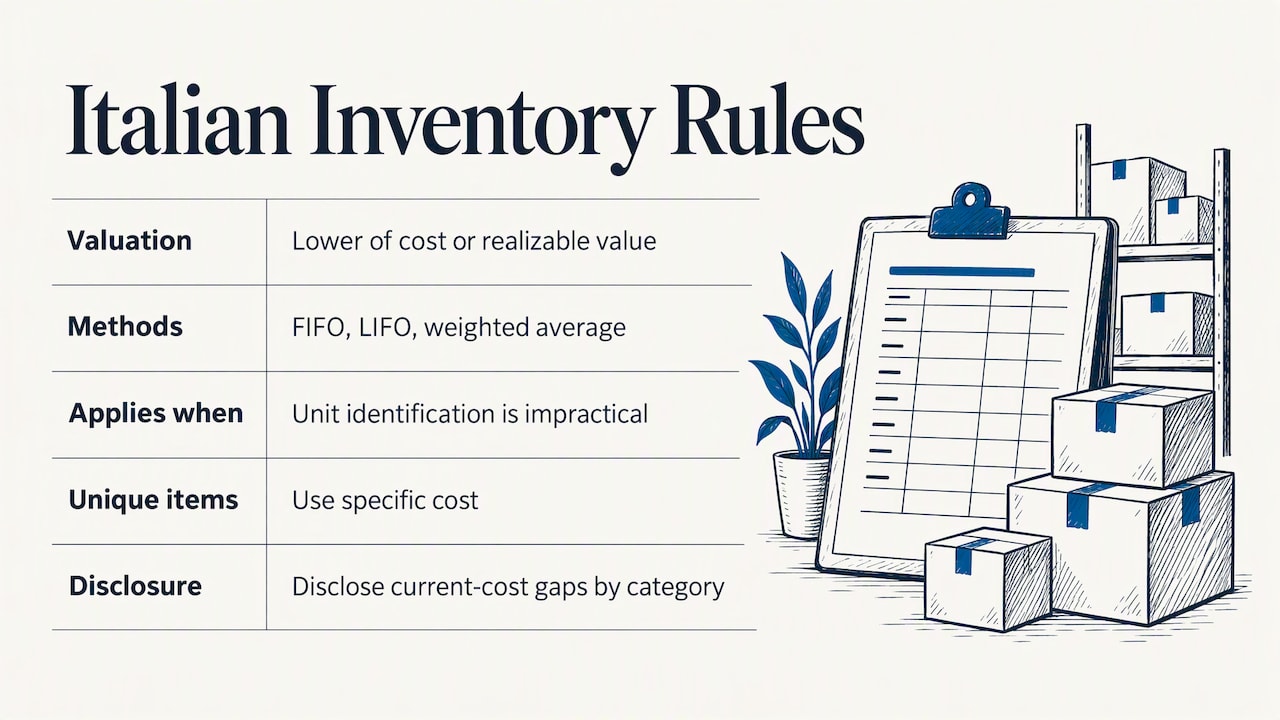
Italian companies that prepare financial statements under the Civil Code follow the national accounting standards issued by the Italian accounting body. OIC 13 on inventories (rimanenze) sets two points that matter for ERP configuration.
Lower of cost and market-derived value. Inventories are valued at the lower of purchase or production cost and the realizable value derived from the market. Your ERP must therefore support a write-down when realizable value falls below cost, and ideally a documented reversal if the reason disappears.
Permitted cost methods. Article 2426, no. 10 of the Civil Code allows weighted average, FIFO and LIFO for interchangeable goods when identifying the specific units is technically or administratively impossible. For items that are unique or tracked by serial or batch, the specific cost applies.
The same OIC document also explains that when the chosen method produces a value that differs appreciably from current closing costs, the difference must be disclosed by category of goods. That means your ERP reports need to calculate the current cost by category, not only the booked value.
The difference with IFRS
If your group reports under IFRS, the rule is narrower. IAS 2 permits FIFO or weighted average cost for interchangeable inventories and applies the chosen formula consistently to inventories of a similar nature. LIFO is not on that list. A subsidiary of an international group may therefore need a method that works in both reporting packages, and the ERP should be able to produce the reconciliation.
Tax treatment of the closing stock value has its own rules. Confirm them with your accountant before choosing LIFO or changing method. If you are following regulatory changes in your software, see our summary of ERP regulatory updates for 2026.
How to choose the method for your business
Use these criteria in order.
- Reporting framework. If any reporting package is IFRS, exclude LIFO. If you only report under OIC, LIFO is legally possible but harder to defend and to reconcile.
- Physical flow. If goods really rotate oldest first (expiry dates, seasonal collections), FIFO mirrors reality and is simple to audit.
- Price volatility. If prices of raw materials change often and goods are mixed, weighted average avoids margin noise between near-identical orders.
- Product type. Serialized or batch-tracked items should use specific identification, which an ERP handles through lot or serial numbers.
- Manufacturing. For production, decide how you value work in progress and finished goods. A cost that includes materials, labor and allocated overhead requires reliable bills of materials and routings. If your shop floor feeds the ERP, see our guide on ERP and MES integration.
- Sales channels. An online shop that sells the same stock as a store needs one valuation source. Our guide to WooCommerce and ERP integration covers how stock and prices move between the two.
Standard cost is a fourth option in many ERPs, used in manufacturing to compare actual against planned cost. Under Italian rules, the balance sheet value still has to reflect actual cost, so standard cost needs a variance process that brings the value back to it.
Configuration checklist for an Italian company
Before go-live, check these points with your consultant and your accountant.
- One method per category. Define the method for each group of interchangeable goods and keep it consistent across periods. Document any change and its effect on the financial statements.
- Valuation level. Decide whether cost is calculated by item, by warehouse or by company. Calculating by warehouse may produce different costs for the same code.
- Landed costs. Decide which purchase costs enter inventory: freight, customs duties and other directly attributable charges. Align this with the cost definition in OIC 13. If you trade with other EU countries, check how your declarations interact with stock movements in our Intrastat in ERP guide.
- Accounts mapping. Link each product category to its stock, cost of goods sold, variance and write-down accounts.
- Negative stock. Decide whether the system blocks sales when quantity is zero. Negative stock breaks FIFO layers and weighted average calculation.
- Opening balances. Load opening stock with a valid unit cost, taken from your last closing, and reconcile it to the ledger before the first transaction.
- Write-down rule. Define how realizable value is estimated for slow-moving or obsolete items and who approves it.
- Parallel test. Run one month of real purchases and sales in a test environment and compare the result with your current figures.
- Period closing. Block back-dated movements after closing, because they change cost layers and averages.
The long-term cost of a poorly configured valuation is bigger than the license. For a way to measure it, read our practical guide to ERP total cost of ownership.
Common mistakes
Accepting the default. Many systems default to one method. Choose it from your own criteria and document it.
Mixing methods without a rule. Two methods for similar goods make comparisons meaningless and make the audit harder.
Ignoring the warehouse process. Valuation depends on correct receipts and shipments. If goods are shipped before they are received in the system, the cost is wrong. A warehouse management system keeps the physical flow and the system flow aligned.
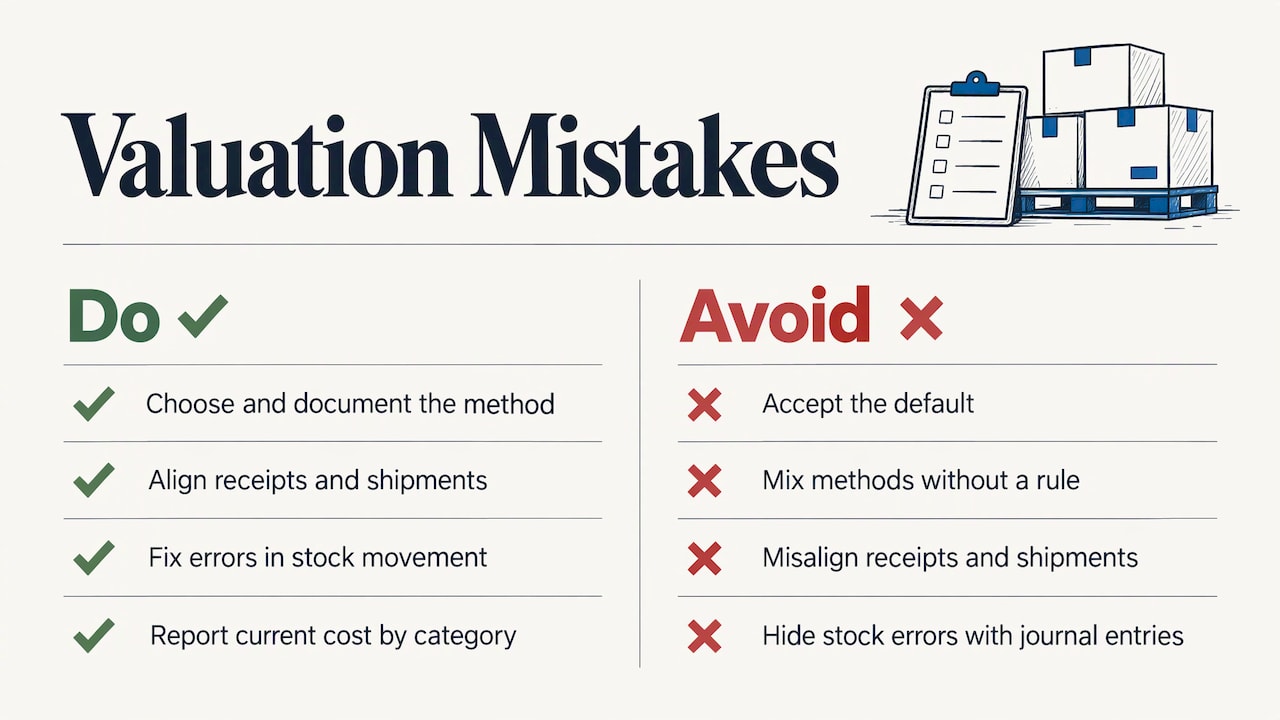
Correcting by journal entry. A manual adjustment in the ledger hides a subledger error and breaks the reconciliation. Fix the cause in the stock movement.
Forgetting the closing disclosures. The system holds the cost, but the explanatory notes need current cost by category. Build that report during configuration.
Our perspective
We have configured ERP systems for manufacturers, retailers and professional studios for 30 years, and valuation is the setting that most often gets decided last and regretted first. It is usually left to a default because nobody in the project owns it.
Our approach is to make it a joint decision between the company’s accountant and the person who runs the warehouse. Each client has a dedicated consultant, not a call center, who studies how goods actually move, which costs belong in stock, and which reports the accountant needs at closing. Only then do we configure the method.
That is the advantage of an integrated ecosystem that covers accounting, production and sales: one stock value, one set of accounts, no re-keying between systems. The method becomes a configured rule, and the consistency Italian rules ask for becomes a property of the system, not a matter of discipline.
Claudio
Configuring valuation with Linkware
We configure Passepartout-based management software to the way your company buys, produces and sells, including stock valuation, ledger postings and the reports your accountant needs at year end. Your dedicated consultant works with you on the method, the account mapping and the test before go-live, and then supports you directly afterward.
If you want to see how valuation, warehouse and accounting work together on your own data, request a demo of our custom ERP solutions. If you sell online, we also connect the ERP to your shop so stock and prices stay aligned. Our customization guide explains when tailoring is worth it and how to govern it.
FAQ
Which inventory valuation method is best in an ERP?
There is no single best method. FIFO suits goods that rotate oldest first, and weighted average suits mixed or commodity-like goods with changing prices. If you report under IFRS, LIFO is not available, so most Italian SMEs choose between the first two. Decide with your accountant and apply the choice consistently.
Is LIFO allowed in Italy?
Article 2426, no. 10 of the Civil Code lists LIFO alongside FIFO and weighted average for interchangeable goods, according to OIC 13. It is not permitted under IAS 2, so a company with IFRS reporting cannot use it there. Check the tax effects with your accountant before adopting it.
Can I change the valuation method later?
You can, but a change affects profit and must be applied consistently and explained in the financial statements. In an ERP it also means recalculating cost layers or averages from a defined date. Plan it at a fiscal year boundary and test it on a copy of your data first.
What does the ERP post when goods are received or sold?
With perpetual valuation, a receipt increases the stock account and a sale posts cost of goods sold against stock, both at the cost given by your chosen method. Some systems use intermediate input and output accounts until the supplier invoice arrives. Your consultant maps these accounts during configuration.
Does inventory valuation affect taxes?
Yes. Closing stock value changes the result for the period, and so the taxable base. The exact treatment depends on your company type and the current rules, so confirm it with your accountant, especially before changing method.
Recommended
Vuoi digitalizzare la tua azienda?
Un consulente LINKWARE ti propone la soluzione su misura, senza impegno.
Richiedi una demo gratuita