
Blog · Gestionale
MES for Manufacturing: What It Does and When You Need It
A MES (Manufacturing Execution System) is software that follows production on the shop floor as it happens. It collects data from machines and operators, tracks each work order, and sends the results back to the ERP. If your ERP tells you what you planned but not what is actually happening on the line, a MES closes that gap. This guide explains what it does, how it differs from ERP and MRP, and how a small or medium manufacturer can adopt it without buying more system than it needs.
TL;DR
- A MES manages and records production in real time: orders, machine status, quality, traceability and OEE.
- ERP plans the business and MRP plans materials. The MES executes and measures what happens on the shop floor.
- Most failed projects come from poor base data and weak change management, not from the software.
- For SMEs, a modular rollout that starts with one department or one problem works better than a full installation.
- The MES must integrate with the ERP you already use. A standalone system creates a second source of truth.
Table of Contents
- What a MES does in a factory
- MES vs ERP: where one ends and the other begins
- MES vs MRP: a different job
- MES and WMS are not the same either
- When a MES is worth considering
- The context in Italy
- What to prepare before choosing software
- A staged rollout for SMEs
- Our perspective
- How Linkware can help
- FAQ
What a MES does in a factory
Think of the factory in three layers. At the bottom are machines, PLCs and sensors. At the top is the management system: quotes, purchasing, inventory, invoicing. The MES sits in the middle and translates between the two.
The Fraunhofer IPA describes the MES as a two-way bridge between the management level (ERP) and the operating level (machines and IoT sensors). In practice it covers these functions:
- Order management: the work order released by the ERP reaches the department with its routing, bill of materials and quantities.
- Real-time monitoring: running, stopped and waiting machines, with the reason for each stop.
- Traceability: which lot of raw material went into which finished product, on which machine, with which operator.
- Quality control: checks at defined steps, with scrap and rework recorded against the order.
- Efficiency analysis: OEE (overall equipment effectiveness), cycle times and real versus standard costs.
The benefit is less manual data entry. Paper job cards and end-of-shift spreadsheets arrive late and contain errors. A MES records the event when it happens, so a deviation is visible to the production manager while there is still time to act.
MES vs ERP: where one ends and the other begins
The two systems are often confused because both handle production orders. They answer different questions.
| ERP | MES | |
|---|---|---|
| Main question | What should we produce, buy and sell? | What is happening on the line now? |
| Time horizon | Days, weeks, months | Seconds, minutes, shifts |
| Typical data | Orders, stock, costs, invoices | Machine states, cycle times, scrap, lot genealogy |
| Users | Office, planning, purchasing, accounting | Operators, supervisors, quality, maintenance |
| Level in the ISA-95 model | Level 4 | Level 3 |
The ERP sees production after the fact, when the order is closed and the data is entered. The MES sees it during execution. For that reason the two work best as one flow: the ERP sends orders and master data down, the MES sends actual times, quantities, scrap and consumption up. Academic work on design variants for implementing MES and ERP together shows that the integration architecture is a design decision in itself, not a detail to settle at the end.
If you want a deeper look at how the integration is structured, our guide on what a MES is for manufacturing SMEs walks through it with examples.
MES vs MRP: a different job
MRP (material requirements planning) is a calculation. Starting from demand, bills of materials and stock, it works out what to buy or make and when. It is usually a module inside the ERP.
A MES does not calculate requirements. It executes the plan and records what really happened. The two connect at one point: MRP produces a schedule that assumes standard times and yields, while the MES shows how far reality departs from those assumptions. When actual cycle times or scrap rates feed back into the master data, the next MRP run becomes more reliable.
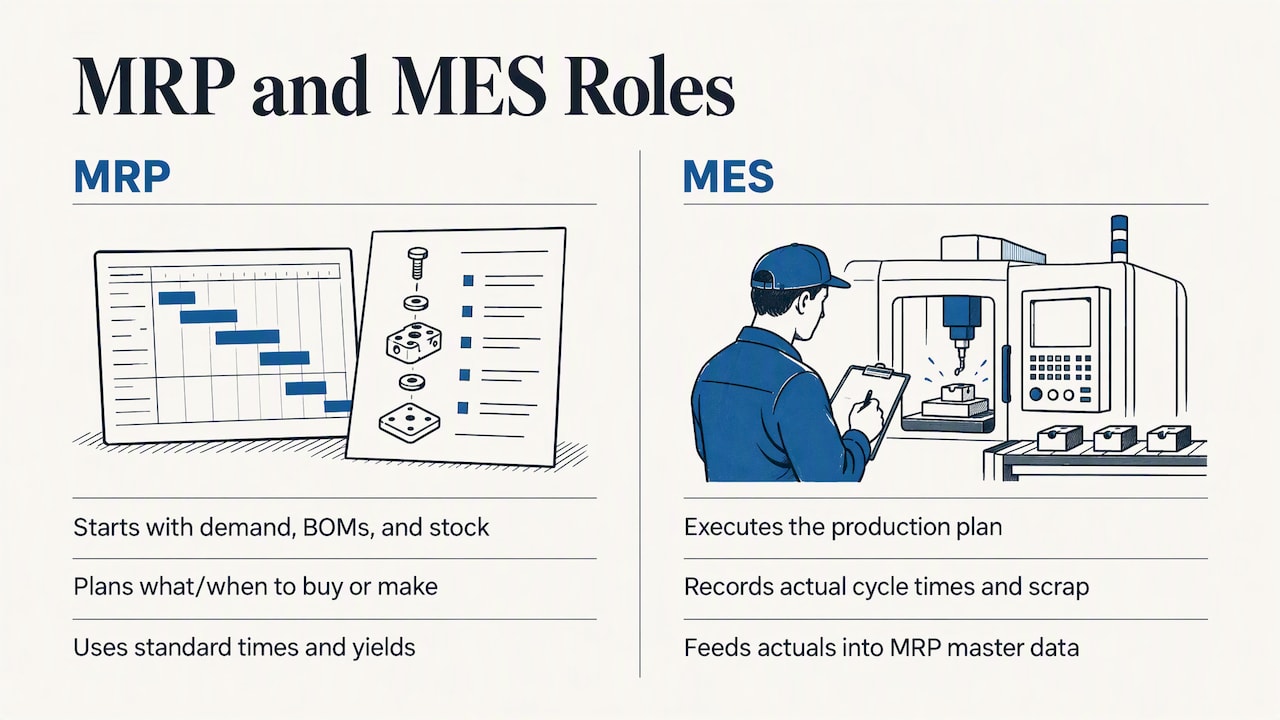
A simple rule: MRP says what should be made, the MES shows what is being made and how well.
MES and WMS are not the same either
A third confusion involves the warehouse management system. The il software WMS per il magazzino controls locations, picking and movements in the warehouse. The MES controls transformation on the line. They meet at material feeding and finished goods put-away. If line stoppages come from missing components, the real issue may be the interface between the two, as we explain in our article on MES vs WMS and how to integrate them.
When a MES is worth considering
Not every workshop needs one. These are the signals we see most often in Italian manufacturers:
- You cannot say in minutes where an order is. Planning calls the floor, the floor checks a sheet.
- You do not know the real reasons for downtime. Stops are estimated at the end of the shift, if at all.
- Traceability takes days. A customer or auditor asks which lots went into a delivery and the answer requires searching several files. Our guide to order tracking in production for SMEs covers the practical side.
- Costs on the job card differ from the final costs. The estimate is wrong but you do not know where.
- You plan to use incentives or customers’ requirements tied to interconnected machines. Our page on MES software for Industry 4.0 and 5.0 explains when a MES supports these requirements. Check the current rules with your accountant before committing to a purchase.
If none of these apply and you run a few simple operations, a well-configured ERP production module may be enough for now.
The context in Italy
Italian manufacturers are innovating. According to Istat, 55.7% of companies with at least 10 employees introduced innovations in 2020-22. Yet the Istat 2024 annual report notes that ERP adoption and automatic data exchange with suppliers still lag behind the average of the larger EU economies, even though over 60% of firms with 10 or more employees were using cloud computing services in 2023. For an SME this means a MES connected to the ERP is not a luxury of large groups. It is one of the ways to catch up on process visibility.
There are also Italian examples at small scale: an Italian company has developed a customizable MES to connect machines according to client requests, and a European digital innovation hub describes how a foundry digitalized data collection across its production cycle to give management real-time insight into each phase.
What to prepare before choosing software
The Fraunhofer IPA market overview is blunt on this: the most frequent mistake is ignoring sector-specific needs, such as the difference between series production and one-off jobs, which leads to oversized systems nobody uses. A few points follow.
Clean the base data first
A MES depends on item master data, routings and bills of materials. If these are wrong in the ERP, the MES will display the inefficiency faster, not fix it. The recommended first step is data cleaning and standardizing flows, before any technical configuration. Count how many items have no routing, how many routings have outdated times, and how many bills of materials differ from what operators actually assemble.
Improve the process before automating it
Automating a disorganized process gives you a disorganized process with a screen. Decide the standard way of working in each department first, then configure.
Choose for integration, not for the longest feature list
The same Fraunhofer analysis recommends choosing a MES for its ability to fit into your existing ecosystem rather than as an all-in-one answer. Ask how it exchanges data with your ERP: which fields, in which direction, how often, and what happens when a message fails.
Plan for people
Research from the University of St. Gallen on Industry 4.0 technologies in German-speaking countries found that the positive effect on performance depends on internal skills, not only on the software architecture. Operators will have to enter data in real time, and supervisors will see every deviation. Without training and an explanation of why, adoption stalls. Our guide to ERP change management covers this in detail.
A staged rollout for SMEs
A modular approach lowers risk. A typical path looks like this:
- Map and clean. Document flows, correct master data, choose the three or four KPIs that matter.
- Pilot on one department or line. Start with order feedback and downtime reasons, using terminals or tablets.
- Add machine connection. Connect machines where automatic data adds value over manual entry.
- Extend to traceability and quality. Lots, serial numbers, checks and non-conformities.
- Measure and refine. Compare results with the baseline from step 1 and adjust.
The KPIs are worth choosing before you start. OEE is the usual first measure, and our guides explain how OEE and MES work together and practical ways to improve OEE in production. For a broader view, see production KPIs in the ERP and how to connect them with MES and BI.
Do not forget the people on the floor
Production monitoring also touches shift planning and attendance. Where staff work across several shifts or sites, tools for workforce scheduling and time tracking can complement the picture the MES gives you of machines and orders.
Our perspective
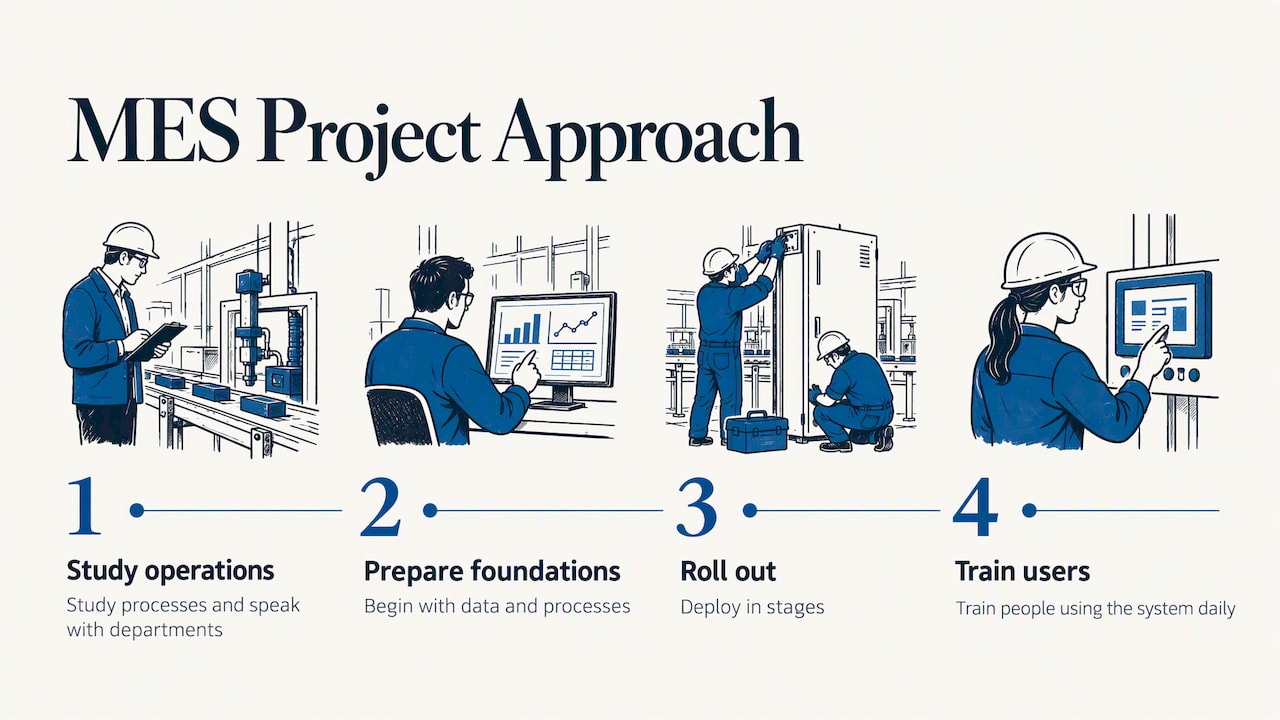
In our experience with manufacturing clients, the projects that work are the ones where someone has first understood how the company really produces. That is why we do not start from a catalog. A dedicated consultant studies your processes, talks to the people in the departments and proposes a configuration that matches your operations. You are not routed to a call center: the same team handles development and user support, so the person who hears about a problem is able to fix it.
We also see the same pattern the research describes. A MES is rarely rejected because of its technology. It is rejected because operators were not involved, or because the data it received was unreliable. So we begin with data and processes, we roll out in stages, and we train the people who will use the system every day. The ERP and the MES should speak one language and share one set of master data. This is why, as Passepartout partner with over 30 years of experience, we build the MES on the same ecosystem as the management software, so accounting, production and sales sit in one flow.
— Claudio
How Linkware can help
Linkware configures MES software for manufacturers as part of an integrated ERP ecosystem based on Passepartout solutions, with training, start-up and professional support included in the engagement. If you want to see how order feedback, traceability and OEE would look on your own production data, you can explore our MES software for Industry 4.0 and 5.0 and request a demo tailored to your company. If you prefer to talk first about your overall management system, start from our custom ERP software offer.
FAQ
What does MES mean in software?
MES stands for Manufacturing Execution System. It is software that monitors, controls and documents production in real time, from the work order to the finished product. It connects the ERP with machines and operators on the shop floor.
Do I need a MES if I already have an ERP?
Not always. If your processes are simple and your ERP production module gives you the data you need, it may be enough. A MES becomes useful when you need real-time visibility of orders, downtime, quality and lot traceability, and when manual feedback arrives too late or too inaccurately.
Can a small company implement a MES?
Yes, if the rollout is modular. Start with one department and a small set of KPIs, then extend. The European Enterprise Europe Network material on SMEs stresses staff training and cultural change as the points most often underestimated, so budget time for them.
Is MES the same as MRP?
No. MRP calculates what materials to buy or produce and when. A MES manages the execution of that plan on the line and records what actually happened. The data the MES collects can improve the standard times and yields that MRP relies on.
Should the MES be connected to the ERP?
Yes. Without integration you keep two separate sets of data and re-enter information by hand. The most useful setup is two-way: orders and master data from ERP to MES, actual times, quantities and scrap back to the ERP.
Recommended
Vuoi digitalizzare la tua azienda?
Un consulente LINKWARE ti propone la soluzione su misura, senza impegno.
Richiedi una demo gratuita