
Blog · Gestionale
Shop Floor Data Collection: How to Connect Machines to Your ERP
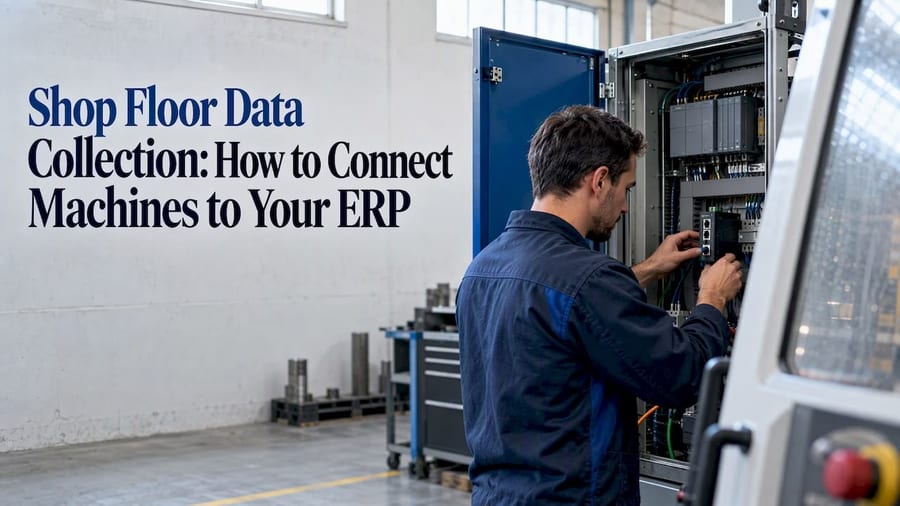
Shop floor data collection means capturing what happens in production (quantities, times, stoppages, scrap, materials used) as it happens, and sending it to the systems that plan and account for the work. In practice, you do it with a mix of machine connections (PLCs, sensors), operator input on terminals or tablets, and a Manufacturing Execution System (MES) that passes clean data to your ERP. This guide explains what to collect, how to connect machines, where projects go wrong and how to start in a small or mid-sized manufacturing company.
TL;DR
- Collect only the data that answers a decision: output, downtime and its causes, scrap, cycle times, and the materials and lots consumed.
- Combine two sources: automatic signals from machines and structured input from operators. Neither is enough alone.
- The MES sits between the machines and the ERP. It filters, time-stamps and contextualizes data, then feeds orders, costs and traceability in the ERP.
- Most failures come from operator adoption, weak network and security planning, and unclear definitions, not from the technology itself.
- Start with one line or one department, define the KPIs first, and extend after the data has proven reliable.
Table of Contents
- What shop floor data collection actually covers
- What to collect, and why
- How machines are connected
- Edge hardware: the part that gets underestimated
- The role of the MES between machines and ERP
- Why the ERP stays at the center
- Where projects fail
- Cloud or on-premise for the data
- The Italian context
- A practical way to start
- Our perspective
- Talk to us about your production data
- FAQ
What shop floor data collection actually covers
The phrase is used for three different things, and mixing them causes confusion in projects.
- Machine data: signals from PLCs, CNC controls, sensors and counters. Machine on or off, parts counted, alarms, temperatures, pressures.
- Operator data: what a person must declare because a machine cannot know it. Which production order is running, why the line stopped, how many pieces were rejected and for what reason.
- Material data: which raw material lot, component or serial number went into which finished product.
A machine can tell you it stopped for 22 minutes. Only the context tells you whether it was a changeover, a missing component or a breakdown. That is why good collection always combines the first two sources.
What to collect, and why
The most common mistake is to connect everything and decide later. Data without a question behind it becomes noise and storage cost. Start from the decisions you need to make.
| Decision | Data needed | Where it ends up |
|---|---|---|
| Is the line productive? | Run time, stop time, good and rejected pieces, theoretical cycle time | OEE dashboard |
| Why do we lose time? | Stop events with a cause code chosen by the operator | Pareto of downtime causes |
| What did the job really cost? | Actual hours per order and phase, materials consumed, scrap | ERP job costing |
| Can we trace a defect? | Lot and serial numbers per production order | Traceability records |
| Will we ship on time? | Quantities completed per phase against the plan | Production planning |
If you want a deeper look at the indicators, our guide to production KPIs in ERP explains which ones to monitor and how to integrate them with MES and BI. For the efficiency metric in particular, see how OEE and MES work together.
How machines are connected
The physical side is where many SMEs feel stuck, because a typical Italian plant has machines from several decades and several brands. There are usually four situations.
Modern machines with open interfaces
Recent PLCs and CNC controls often expose data through standard protocols. According to the research we reviewed, integration between ERP and factory data (MES/IoT) is now easier thanks to platforms built on open protocols such as OPC UA, MQTT and Modbus. If your machine offers one of these, collection is mostly a configuration job.
Older machines with a PLC but no standard interface
A gateway or protocol converter can read the PLC registers and republish them in a standard format. This needs someone who understands both the machine program and the network.
Machines with no digital output at all
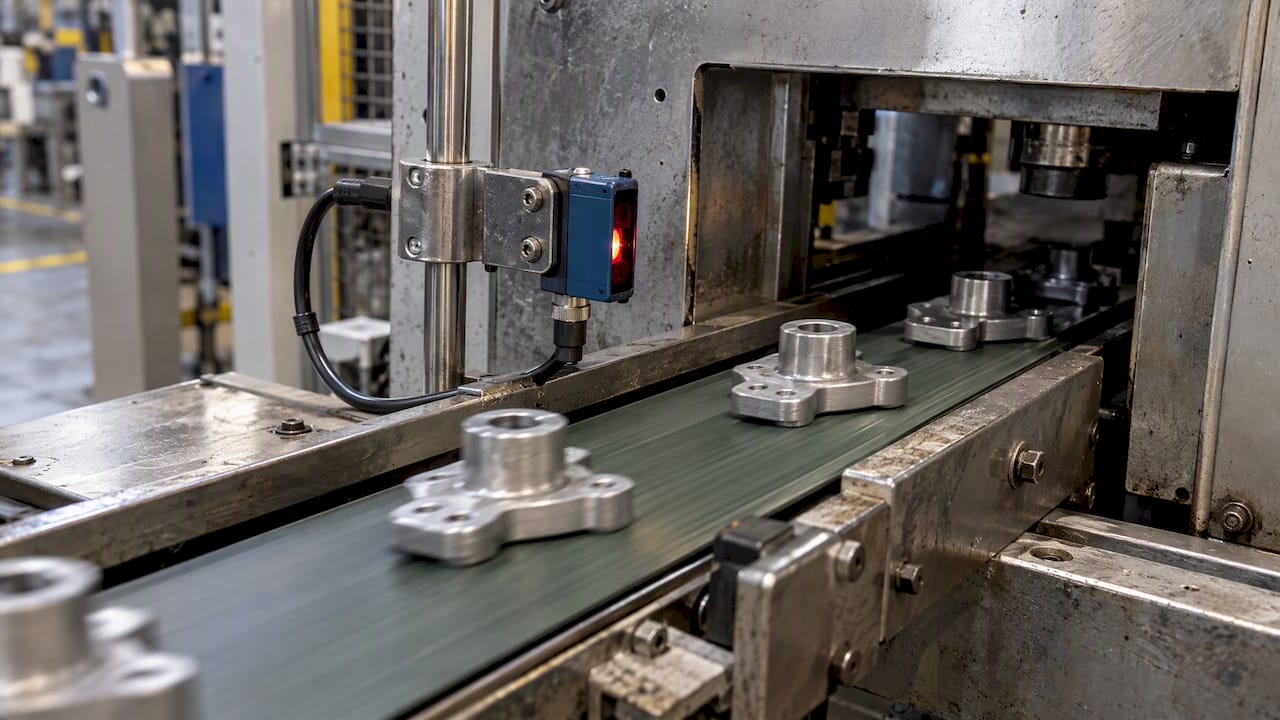
You can add external sensors: a current clamp to detect that the motor is running, a photocell or counter for pieces, a signal from the light tower. It is not elegant, but it often gives you 80% of the value (running or stopped, and how many pieces) at a modest cost.
Manual stations
Assembly, packaging and inspection stations frequently have no machine to read. Here a terminal, tablet or barcode reader is the data source, and the quality of the interface decides the quality of the data.
The Smart OEE project, funded by the EU’s Horizon 2020 programme, developed a data acquisition technology that lets manufacturers monitor production lines in real time. Its documented case studies report efficiency gains of up to 5% in plastic extrusion and up to 15% in food processing. These are results from specific cases, not a promise for every plant, but they show that the effect is measurable on SME lines.
Edge hardware: the part that gets underestimated
Sending every raw signal straight to the cloud is rarely a good idea. Italian public guidance on IoT services points out that companies often underestimate the need for edge computing hardware that filters data before it reaches the cloud. Filtering avoids bandwidth overload and lets the plant keep working and recording if the internet connection drops.
In practice, ask these questions before you buy anything:
- If the connection goes down for two hours, is data buffered locally and sent later without gaps?
- Are time stamps created at the machine, not when data arrives?
- How many signals per second does each machine produce, and do you need all of them?
- Who maintains the gateway when a machine is replaced or reprogrammed?
The role of the MES between machines and ERP
An ERP is built to manage orders, stock, purchasing, accounting and costs. It is not built to listen to a machine every second. The MES covers that layer: it receives machine signals and operator input, links them to a production order and a phase, calculates indicators such as OEE, and passes the results to the ERP in a form the ERP can use.
This answers a question that appears often: machine data integration is not a single connection but a chain.
- Signal: the machine or sensor produces a raw event.
- Contextualization: the MES associates it with an order, a work center, an operator, a lot.
- Validation: it filters micro-stops, flags missing causes and rejects impossible values.
- Posting to ERP: hours, quantities, scrap and consumption update the order, the cost and the stock.
- Analysis: dashboards and BI read the same data for managers.
If you are evaluating this layer, we explain the basics in what an MES is and how it works for manufacturing SMEs, and when it becomes necessary in MES and Industry 4.0. Warehouse and production systems also need to talk to each other; see MES vs WMS for how to choose and connect them.
Why the ERP stays at the center
The value of shop floor data is realized when it changes a figure somewhere else: the real cost of an order, a delivery date promised to a customer, a purchase triggered by actual consumption. If the data stays in a separate dashboard, people consult it for a few weeks and then stop.
That is why we prefer an integrated approach in which accounting, production and sales share one data model. Lot and serial tracking is a good example. When material consumption is recorded at the line, you can answer a customer complaint in hours instead of days. Our article on lot and serial traceability for SMEs covers this, and job traceability shows how to follow an order from release to shipment.
Where projects fail
The causes are rarely technical. Here are the ones we see most often described and discussed in the field.
Operators are not involved
If the line staff see the terminal as outside control, they will click the fastest option, and your cause codes will be wrong. Interfaces must be simple, require few taps and use the words operators actually use. Show them the results too: a board with the line’s own output and stoppages turns data entry into something useful for them.
Definitions are not agreed
What counts as a stop? From how many seconds? Is a changeover planned or unplanned downtime? Without written answers, two shifts will report different numbers for the same event. Define them before configuring anything.
Too many signals, no decisions
Start with the five or six figures that someone will review every week. Add more when the first ones are trusted.
Security is treated as an IT detail
Once machines are connected, a mistake in the network can affect production. The European Union Agency for Cybersecurity (ENISA) recommends that industrial systems map their assets and apply technical measures such as digital certificates, application whitelisting and encryption across the whole device life cycle. A common error is protecting only the cloud while ignoring authentication of individual devices.
A related ENISA presentation recommends that control signals sent from a cloud service to an OT system be filtered and monitored for anomalies, and distinguishes them from telemetry flowing the other way. For a plant, the practical rule is to keep monitoring data one-directional wherever you can, so that collecting data never gives anyone remote control of a machine.
Cloud or on-premise for the data
There is no universal answer. On-premise gives you control and low latency at the plant but means you maintain servers, backups and updates. Managed cloud moves that burden to a provider. Italian guidance on cloud adoption notes that managed solutions reduce the administrative and technical effort of maintaining on-premise servers, leaving SMEs free to focus on their core business.
For shop floor data, a hybrid arrangement is common: a local gateway or server that keeps collecting even without internet, with ERP and reporting hosted in a managed environment. We compare the options in cloud or on-premise ERP and describe the operational side in managed ERP hosting.
The Italian context
Adoption of management software is already widespread. According to Istat’s 2025 report on enterprises and ICT, 56.0% of Italian companies with at least 10 employees use management software (ERP, CRM or BI), and ERP is the most common at 49.5%. The same report shows that the share of companies performing data analysis rose to 42.7% in 2025, from 26.6% in 2023.
The consequence is simple. Many of your competitors already have an ERP, and a growing number analyze their data. The gap now opens between companies whose ERP is fed by real production data and those whose ERP is fed by paper sheets typed in at the end of the week.
A practical way to start
- Pick the pilot. Choose one line or department where the pain is clear: frequent stops, unreliable job costs, or traceability requests from a customer.
- Write the questions. For example: how many hours do we lose per week to changeovers, and why?
- Map the sources. For each machine, note the control type, the available signals and whether a sensor is required.
- Define codes and rules. Stop causes, scrap reasons, minimum stop duration, shift calendar.
- Connect and validate. Run for a few weeks and compare collected data against manual counts. Fix the gaps before you trust the dashboards.
- Integrate with the ERP. Post hours, quantities and consumption to production orders, and check that costs now reflect reality.
- Extend. Roll out to other lines using the same codes and templates.
Change on the people side deserves its own plan. Our guide to ERP change management and the overview of ERP implementation phases can help you organize training and go-live.
Our perspective
We have worked on management software for 30 years, and the pattern is consistent: companies do not struggle to buy technology, they struggle to make it match how they really work. That is why each client has a dedicated consultant who studies the processes and supports the team directly, instead of a call center that sees a ticket number.
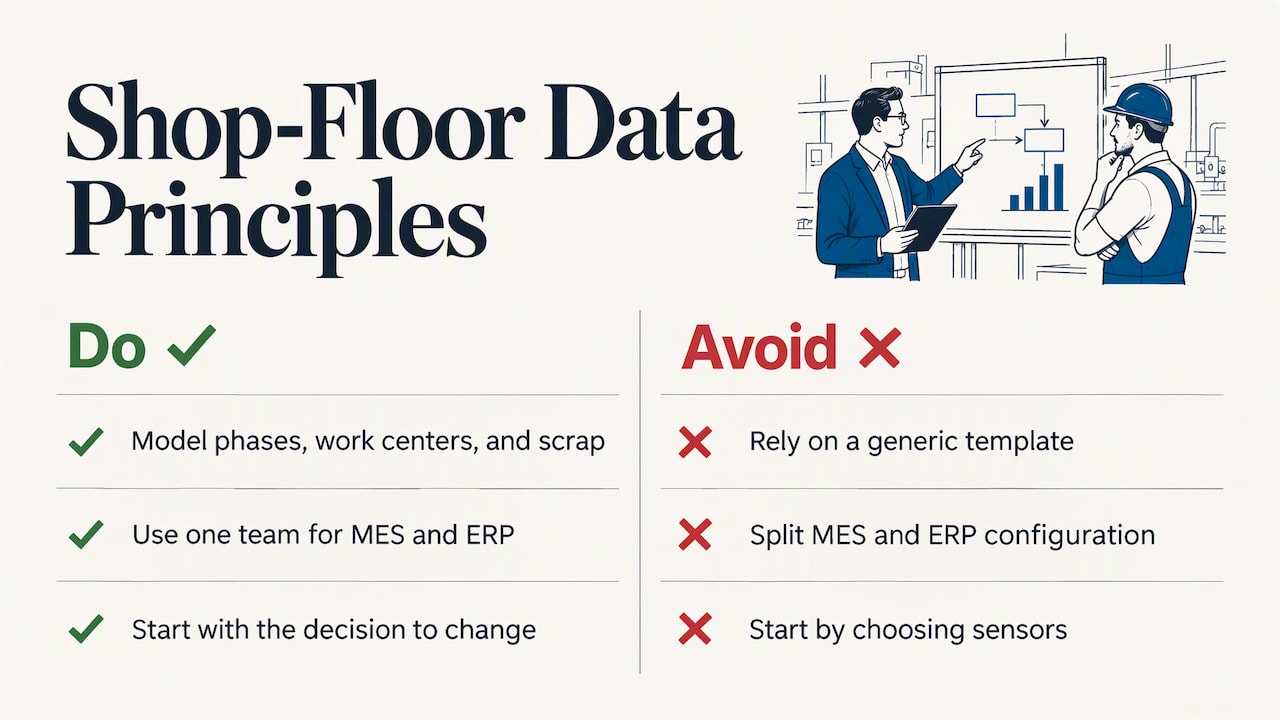
For shop floor data, this matters in three ways. First, the data model must reflect your phases, your work centers and your way of declaring scrap, not a generic template. Second, the people who configure the MES and the ERP should be the same team, because the hardest problems sit at the boundary between them. Third, support must understand the plant: when a stop code is missing at 6 a.m., the person who answers should know your line.
We would also add a note of caution. Do not start by asking which sensors to buy. Start by asking which decision you will take differently once you have the number. Everything else follows from that.
— Claudio
Talk to us about your production data
If you want to connect your machines to the ERP, we can configure the MES software for Industry 4.0 and 5.0 around your lines and integrate it with your management system, including the Passepartout solutions we work with. We also handle training, start-up, professional support and managed hosting. Contact us through linkware.it to describe your plant and request a demo.
FAQ
What is the difference between shop floor data collection and an MES?
Data collection is the activity of capturing production events from machines and operators. An MES is the software that organizes that data by order and phase, calculates indicators and links production to the ERP. You can collect data without an MES, but you then handle context, validation and ERP posting yourself.
Do I need to replace my old machines?
Usually not. Machines with a PLC can often be read through a gateway, and machines without any digital output can be monitored with external sensors that detect running state and piece counts. Replacement makes sense only when a machine is at the end of its life for other reasons.
Which protocols should I know about?
The ones you will hear most are OPC UA, MQTT and Modbus, which the research reviewed above lists as the typical compatibility challenge when connecting different systems. You do not need to master them, but you should ask each machine supplier which one the control supports.
How long does a first project take?
It depends on the number of machines, their age and how clear your definitions are. A single-line pilot is much faster than a plant-wide rollout, which is why we recommend starting small and extending once the data has been validated against manual counts.
Is shop floor data collection only for large factories?
No. The Smart OEE project was aimed at SMEs, and its case studies came from small and mid-sized producers. What changes with size is scope: smaller companies should limit the first phase to a few indicators and one or two lines.
Recommended
Vuoi digitalizzare la tua azienda?
Un consulente LINKWARE ti propone la soluzione su misura, senza impegno.
Richiedi una demo gratuita